 English
 French
 German
 Lithuanian
 Polish
 Spanish
 Dutch
Dutch Italian
 Russian
 Swedish
 Norwegian
 Romanian
 Chinese
Modern life has become increasingly efficient
We can answer emails from anywhere, order groceries with a tap, and communicate across continents in seconds. Yet despite unprecedented convenience, many people feel exhausted, overstimulated, and disconnected from themselves.
Perhaps the problem is not simply how we live.
Perhaps it is where we live.
For centuries, architecture was understood as something far deeper than shelter. Buildings were designed to create experiences. Cathedrals inspired awe. Japanese tea houses encouraged presence. Nordic cabins invited reflection. The spaces people inhabited influenced not only their actions, but their state of mind.
Today, science is beginning to confirm what traditional cultures understood intuitively:
Our environment continuously communicates with our nervous system. Every room sends signals. Every material creates an emotional response. Every space either contributes to stress – or supports recovery.
Biophilic Design & Wellbeing Zhong, chröder & Bekkering (2022)
The Hidden Language of Spaces
Walk into a busy airport terminal.
Bright lights. Constant announcements. Hard surfaces. Crowds moving in every direction.
Your body responds before your mind has time to think.
Heart rate increases. Attention narrows. Stress hormones rise.
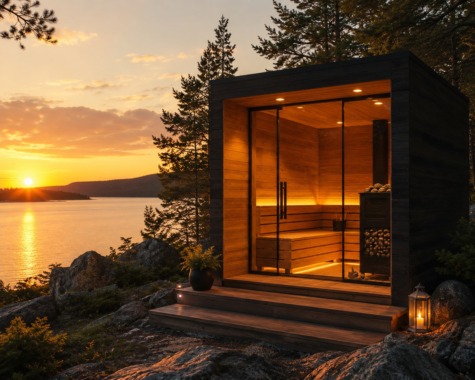
Now imagine entering a quiet sauna nestled among trees.
Natural wood. Soft light. Warmth. Silence.
The nervous system receives a completely different message.
You are safe.
This is not imagination. It is biology.
The human brain evolved in natural environments for hundreds of thousands of years. Modern architecture often prioritizes productivity and efficiency, while overlooking the physiological needs of the people inhabiting it.
The result is a growing mismatch between our environment and our nervous system.
Psychological and physiological effects of a wooden office room on human well-being
Why Natural Materials Feel Different
There is a reason people instinctively reach for wood over plastic.
Wood carries texture, warmth, and subtle imperfections. It ages gracefully. It reflects light softly. It reminds us of nature.
Studies have shown that natural materials can reduce physiological markers of stress and improve perceived wellbeing. Even visual exposure to wood surfaces has been associated with lower sympathetic nervous system activation.
In other words, the materials surrounding us influence how our bodies feel.
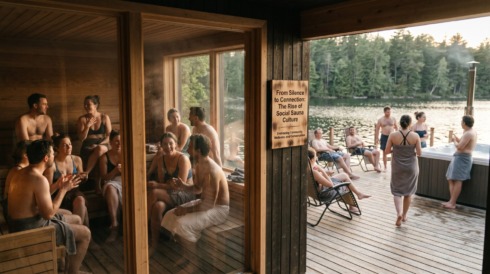
This may explain why traditional sauna culture has endured for generations.
A sauna is not merely a heated room.
It is an environment carefully designed to encourage a shift in state – from doing to being.
The Luxury of Recovery
Historically, luxury was often defined by excess.
More space.
More possessions.
More status.
Today, a different definition is emerging.
True luxury is becoming the ability to recover.
Silence has become rare.
Stillness has become valuable.
Undivided attention has become scarce.
The most desirable spaces are increasingly those that help us regulate rather than stimulate.
A reading nook bathed in natural light.
A quiet garden.
A sauna overlooking a forest.
These spaces are not indulgences.
They are infrastructure for wellbeing.
Designing for the Nervous System
What would happen if we designed environments around human physiology rather than productivity alone?
The principles are surprisingly simple:
* Natural materials
* Soft, layered lighting
* Reduced visual clutter
* Connection to nature
* Spaces dedicated to recovery
* Opportunities for ritual and routine
These elements may seem subtle, yet together they create environments that communicate safety.
And safety is the foundation of nervous system regulation.
When the body feels safe, recovery becomes possible.
When recovery becomes possible, resilience follows.
The Future of Wellbeing
For decades, wellbeing has been treated as something separate from daily life.
A gym membership.
A meditation app.
A weekend retreat.
But wellbeing is increasingly moving into the spaces we inhabit every day.
The future is not adding more activities.
It is creating environments that naturally support restoration.
The architecture of wellbeing is not about designing beautiful buildings.
It is about designing experiences that help people return to themselves.
Spaces that slow the breath.
Spaces that soften attention.
Spaces that remind the nervous system what safety feels like.
Because ultimately, the most powerful wellness technology may not be a device at all.
It may be a room.
A room built for recovery.
A room built for stillness.
A room built for being human.